Launch offer — valid today only

📄 Digital book in PDF · read it on your phone or print it

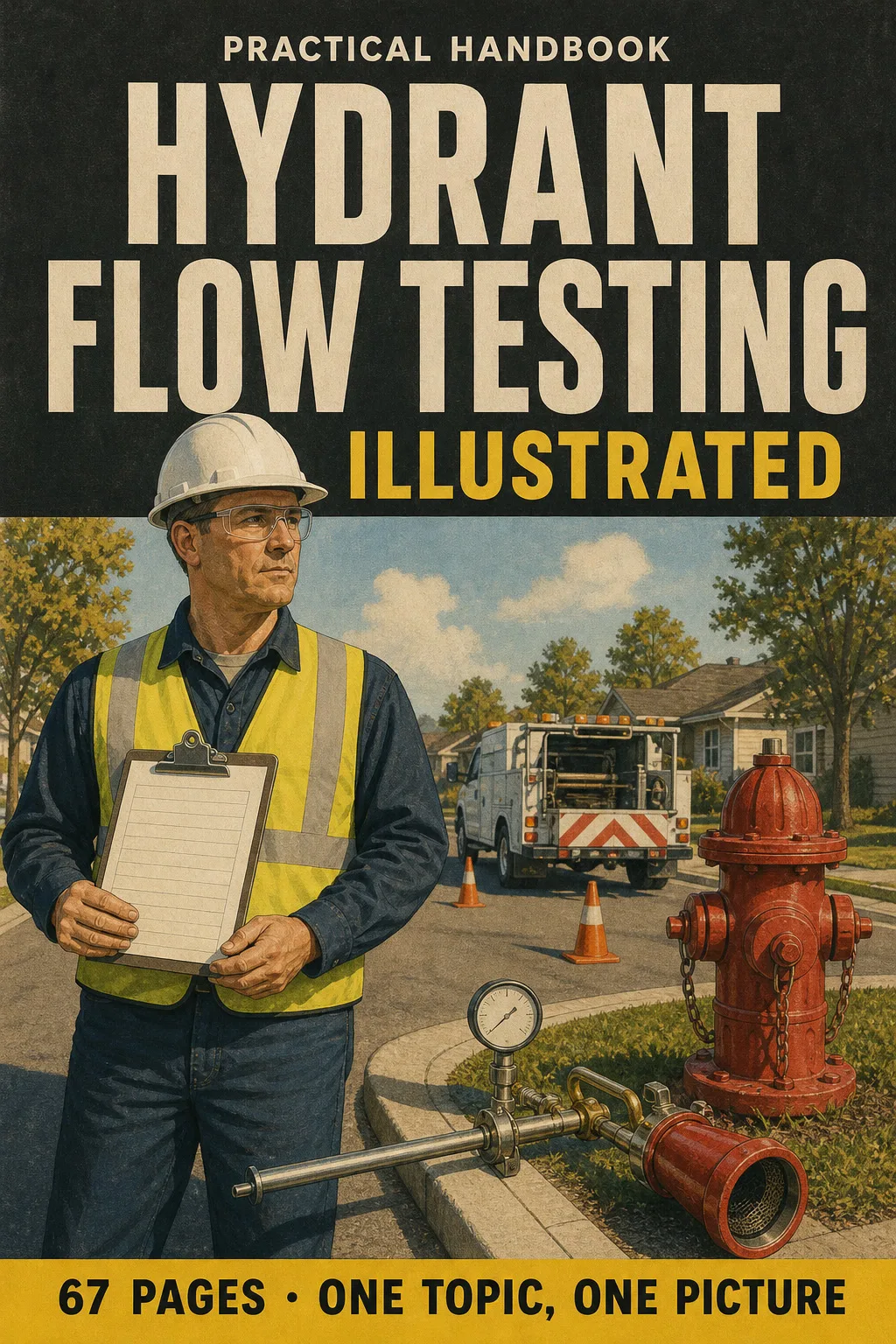
Hydrant Flow Testing, Illustrated: From Pitot Reading to GPM and Q20, the Same Sequence Every Test Every Step on Its Own Page

Static, residual and pitot readings, outlet coefficients, the gpm formula, Q20 and the water supply curve, plus private mains, standpipes and hydrant colors. One topic per page: the drawing first, then what you need to remember. PDF by email, made to print for the truck. 67 illustrated pages.

START LEARNING IT THIS WAY

🔒 Secure checkout · PDF by email · 30-day guarantee

Every topic, its own pageOne 6-step sequence, drawn: pick the hydrants, flush, static, flow and pitot, shut down, gpm and Q20
67 illustrated pages9 parts, from why we flow-test a main to the formula quick sheet
Up-to-date sourcesNFPA 291, NFPA 25 and AWWA Manual M17
PDF by emailFormat

Look Inside the Book

Every page has one big drawing and a box with the readings, numbers and steps you need to know:

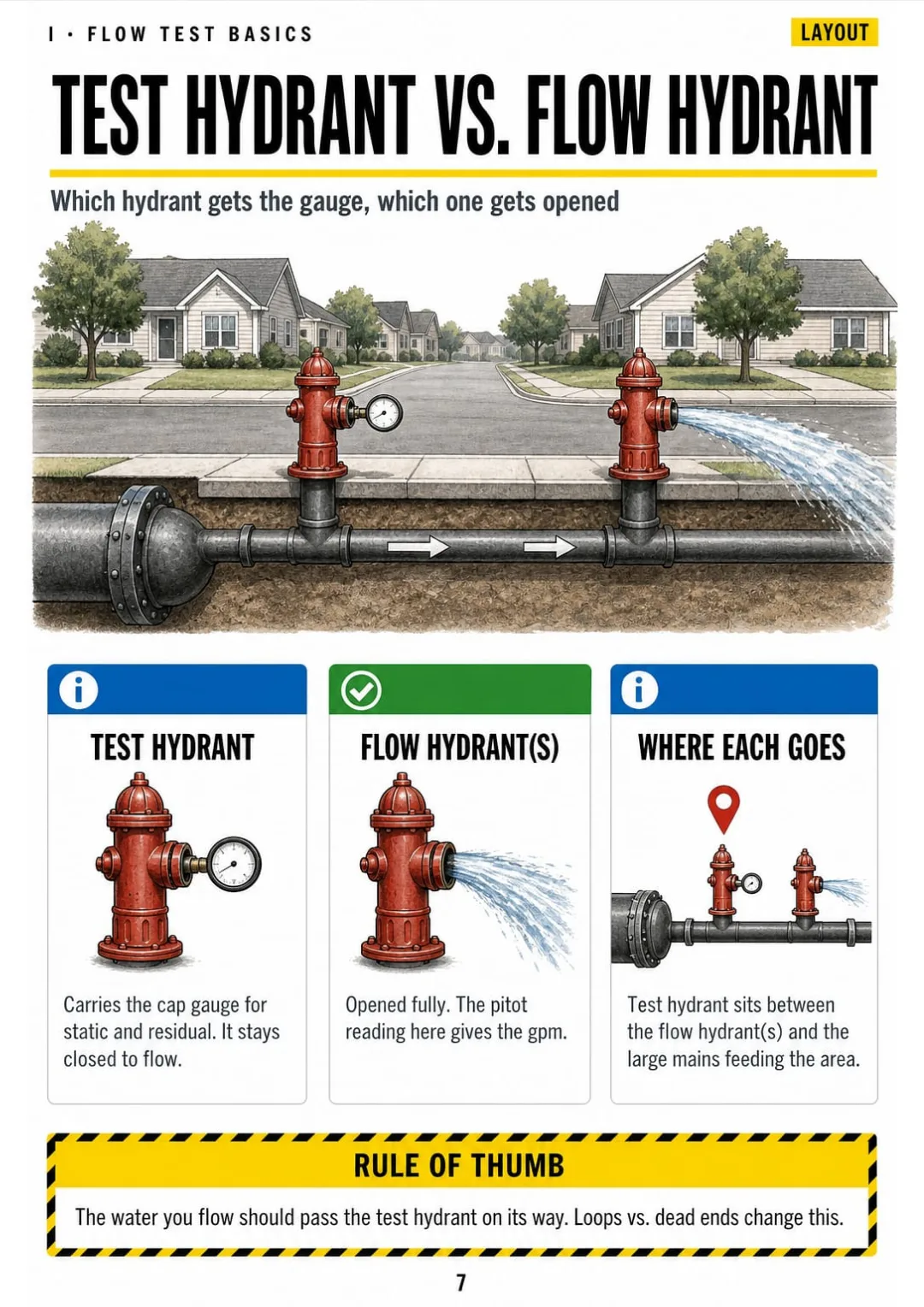
Test hydrant between the supply mains and the flow hydrant, so the flowing water passes it.
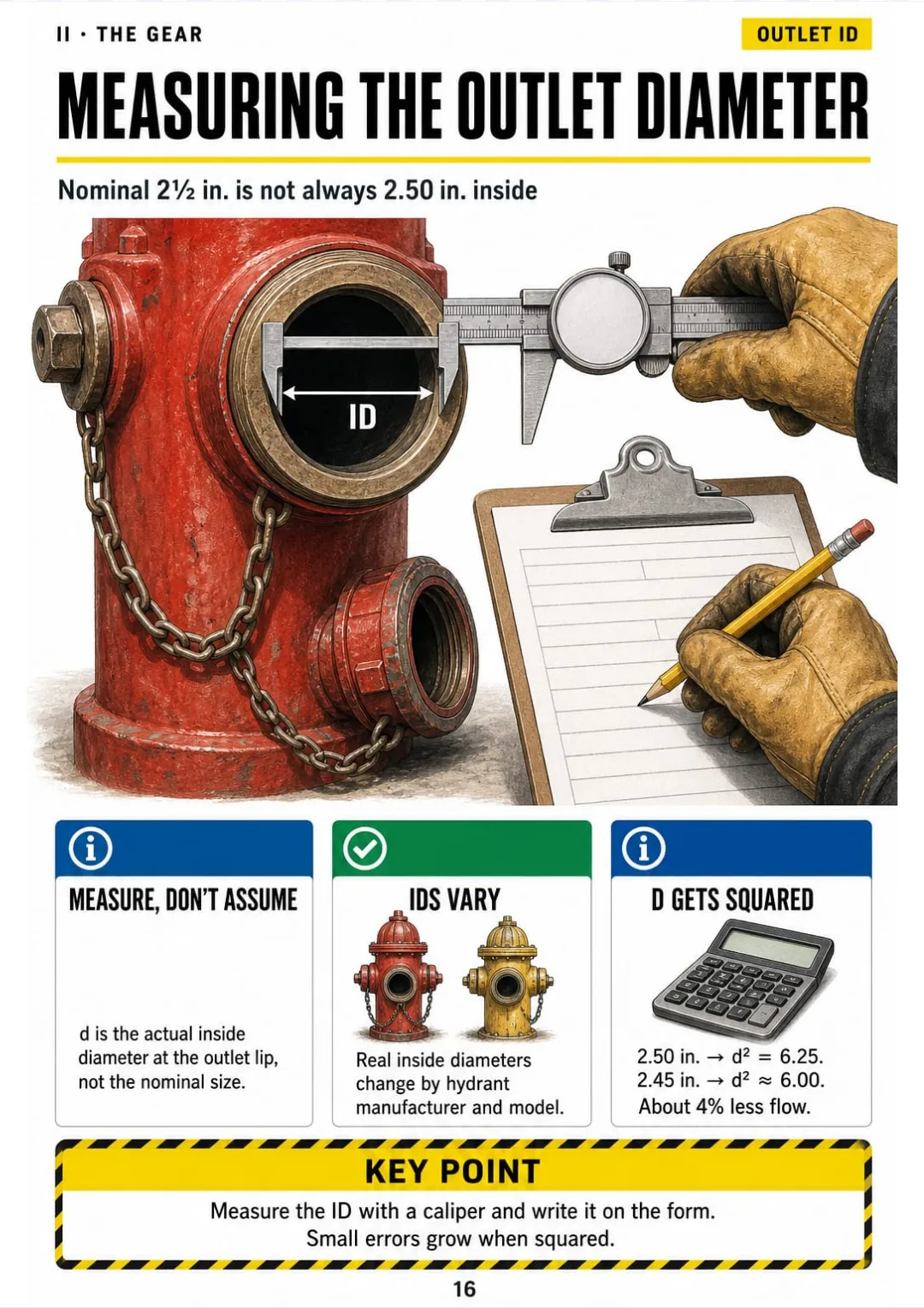
Measured ID, not nominal: 2.45 in. instead of 2.50 in. means about 4% less flow
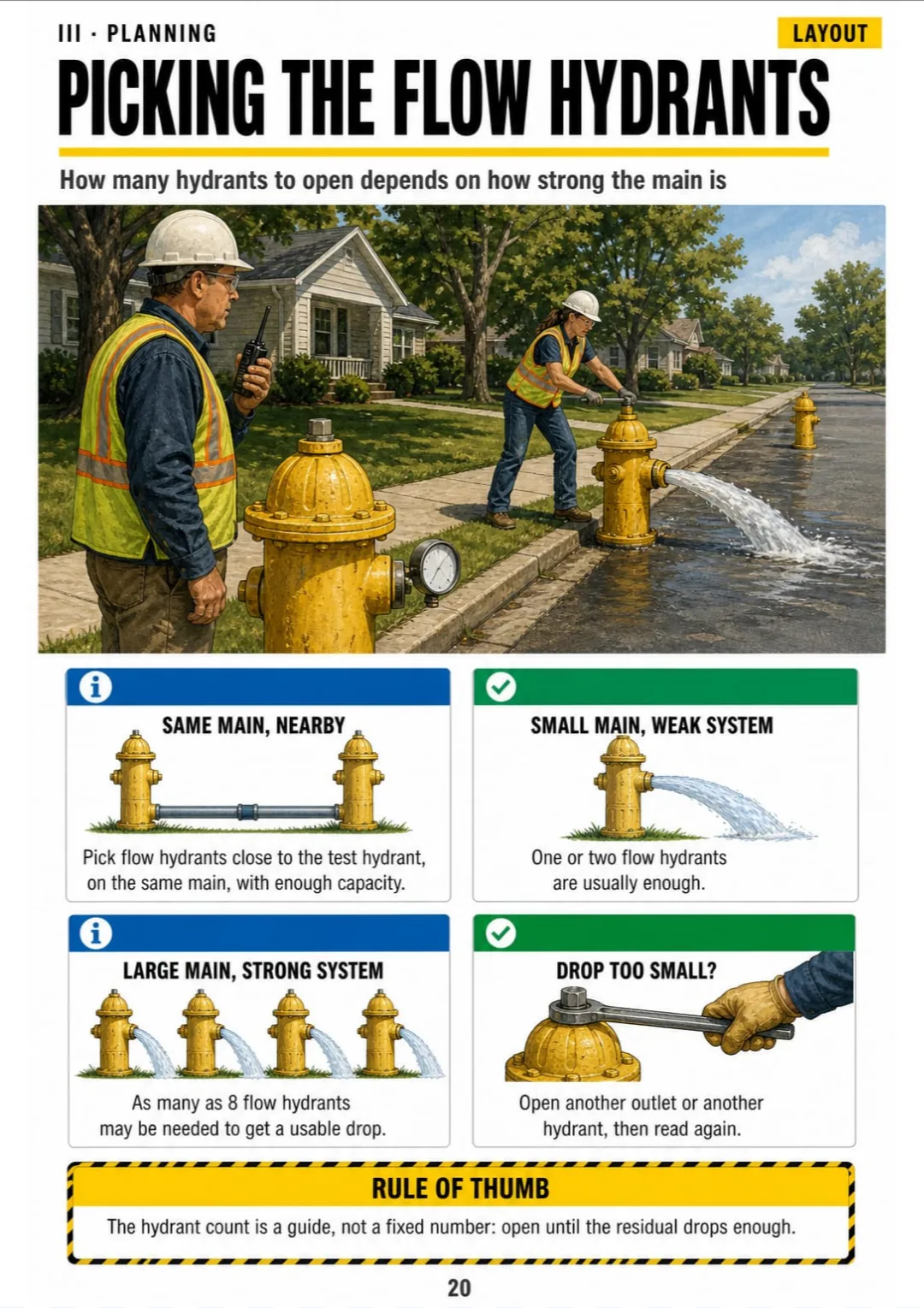
1–2 flow hydrants on small mains, up to 8 on large mains: open until the drop is usable.
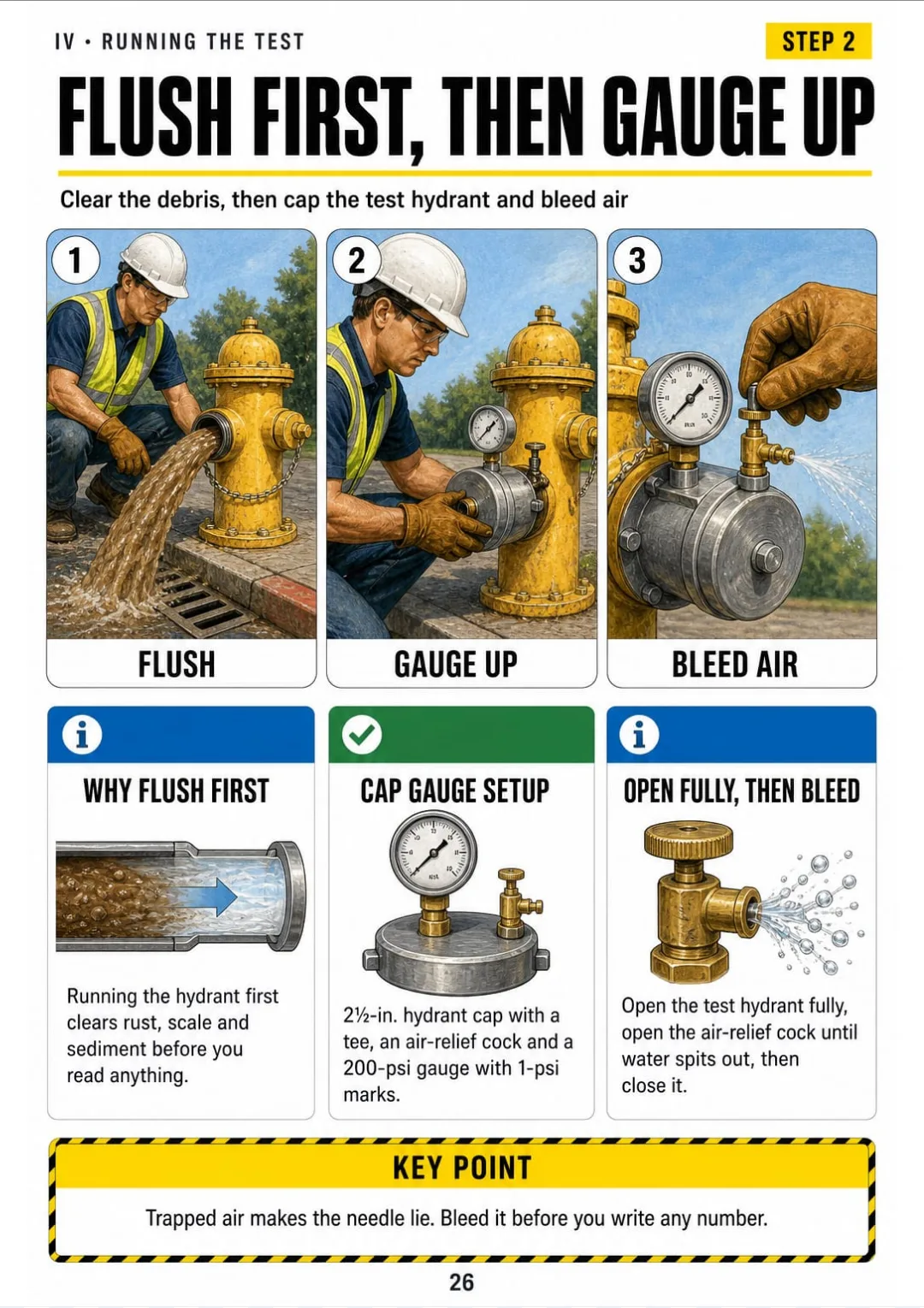
Flush, cap gauge on, bleed the air: three moves before the first reading.
4-in+ outlet at 7 psi or more: multiply Q by 0.83.
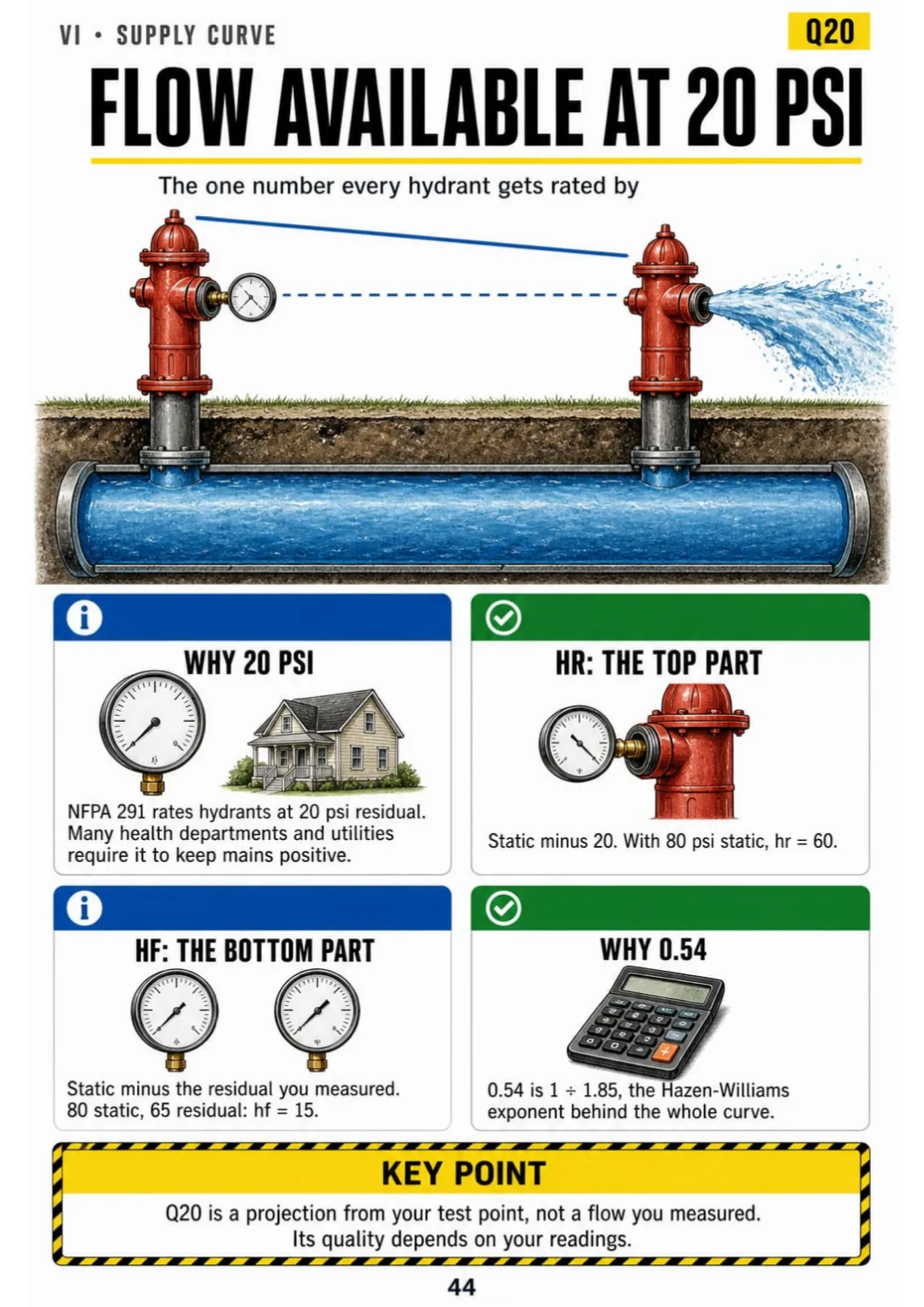
Q20 = QF × ((static − 20) ÷ (static − residual))^0.54
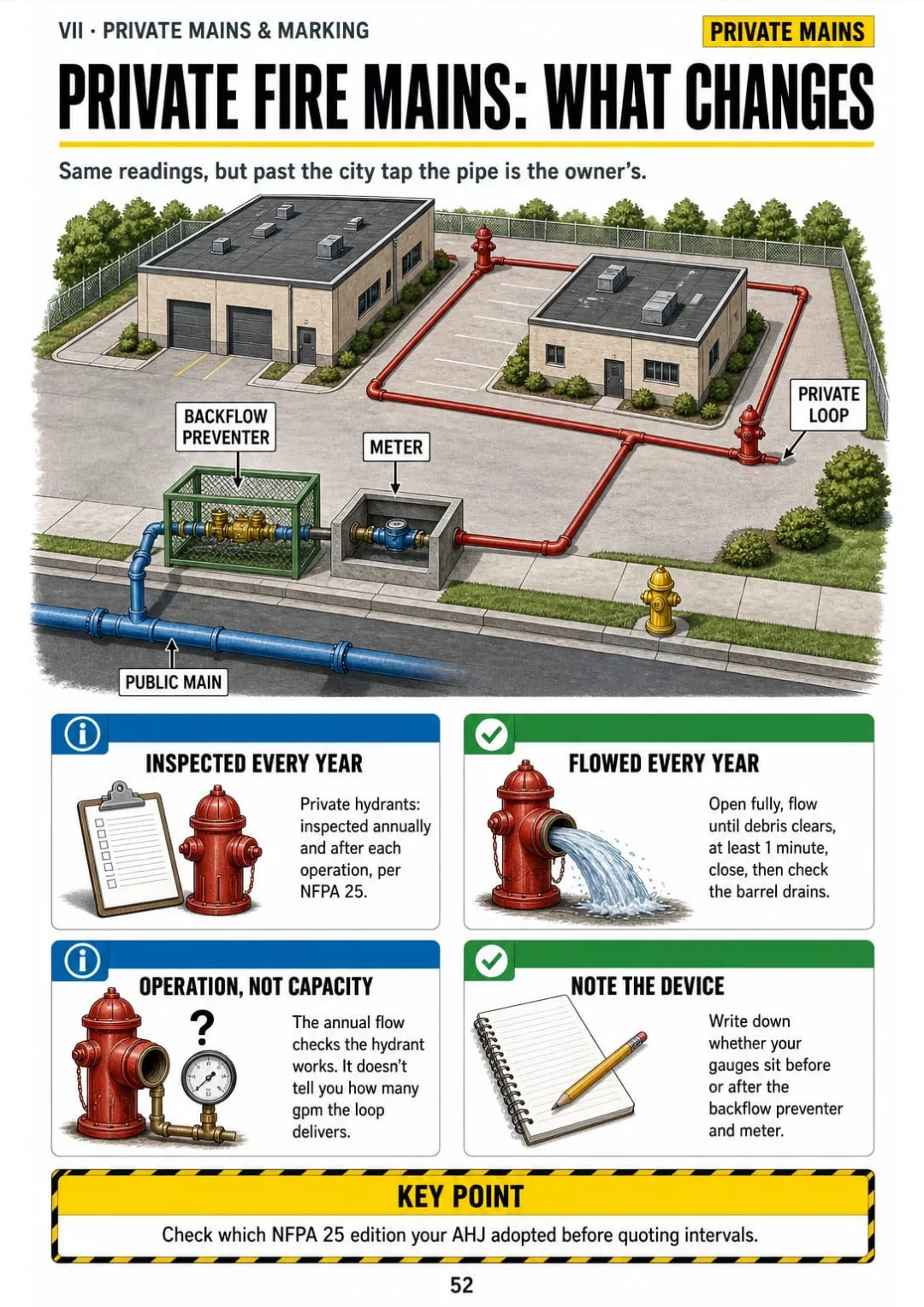
Private hydrants: inspected yearly, flowed yearly for at least 1 minute until debris clears
NFPA 13 (2022): test no more than 12 months old at submittal; some AHJs require 6.

Swipe to see more →

These are real pages from the book. The table of contents is the full one: 9 parts and 63 topics.

The Problem Isn't You. It's How It Was Explained to You.

You're standing on a corner with the hydrant map, two hydrants in sight, and you have to decide which one gets the gauge and which one flows.

The manual covers it in a few dense paragraphs about supply direction and residual pressure. All words, no layout, so out on the street you pick one and hope the engineer doesn't ask why.

1–2 flow hydrants on small mains, up to 8 on large mains: open until the drop is usable.

In this book, picking the test hydrant is one page: the main drawn from the supply, the test hydrant in the middle, the flow hydrant downstream, and why the residual reading only counts that way.

The same goes for the rest: the pitot in the stream, flushing and bleeding the cap gauge, the flow formula, Q20 and the report. Each one has its own page.

You set it up right, you run the test, and you don't go back to the manual on the tailgate.

COMPARE FOR YOURSELF

Same Topic, Two Ways to Learn It

THIS
  • The manual: line after line
  • Pitot position explained only in words
  • You show up to the test with doubts
The pitot tube assembly consists of a blade, an air chamber and a pressure gauge connected to the tube. During the test, the blade orifice should be positioned at the center of the discharge stream, with the opening facing directly into the flow, at a distance from the outlet lip approximately equal to one-half of the outlet's inside diameter. Failure to keep the blade perpendicular to the stream, or allowing the orifice to drift from the center of the jet, will produce erroneous velocity pressure readings and, consequently, inaccurate flow calculations.
FOR THIS
  • The pitot tube and blade in one drawing
  • The distances in a box
  • You see it and you get it
Measured ID, not nominal: 2.45 in. instead of 2.50 in. means about 4% less flow
CONTENTS

Take a Look at the 9 Parts and 63 Topics

What a flow test tells you, the gear, planning, running the test, pitot to gpm, the water supply curve, private mains and marking, the report you sign and the field checks: 67 pages, all illustrated.

IWhat a Flow Test Tells You · pp. 5-11
  1. Why We Flow-Test a Water Main
  2. Static, Residual, Pitot: Three Numbers, Three Gauges
  3. Test Hydrant vs. Flow Hydrant
  4. Where the Water Comes From: Mains, Loops and Dead Ends
  5. Pressure vs. Flow: The Garden-Hose Idea
  6. Who Reads Your Report
  7. The 6-Step Order Used on Every Test
IIThe Gear · pp. 12-18
  1. The Pitot Tube and Blade
  2. Hydrant Cap Gauge for Static and Residual
  3. Gauge Range and Accuracy
  4. Diffusers and Flow Meters
  5. Measuring the Outlet Inside Diameter
  6. Hydrant Wrench, Caps and Radios
  7. The Truck Checklist
IIIStep 1: Planning the Test · pp. 19-25
  1. Picking the Test Hydrant
  2. Picking the Flow Hydrant(s)
  3. How Big a Pressure Drop You Need
  4. Testing Near the Building You're Designing For
  5. Time of Day and System Conditions
  6. Calling the Water Utility First
  7. Traffic, Drainage and Discharge Water
IVSteps 2 to 5: Running the Test · pp. 26-35
  1. Flush First, Then Gauge Up
  2. Reading Static Pressure
  3. Opening the Flow Hydrant the Right Way
  4. Holding the Pitot in the Stream
  5. The Best Pitot Range: 10 to 30 psi
  6. When the Needle Bounces
  7. Pitot and Residual at the Same Moment
  8. Flowing Two or More Outlets
  9. Shutting Down Slowly
  10. What to Write Down in the Field
VStep 6: From Pitot to GPM · pp. 36-43
  1. The Flow Formula, One Piece at a Time
  2. Outlet Coefficient: 0.90, 0.80, 0.70
  3. Worked Example: One 2½-in Outlet
  4. Worked Example: Wrong Coefficient
  5. Worked Example: Two Outlets Flowing
  6. The Big Pumper Outlet
  7. Using a Flow Table Instead of the Math
  8. Elevation Between Gauge and Building
VIThe Water Supply Curve · pp. 44-51
  1. Flow Available at 20 psi
  2. Worked Example: Calculating Q20
  3. N^1.85 Graph Paper Explained
  4. Plotting the Curve Point by Point
  5. Reading Any Flow From the Curve
  6. Supply vs. Demand on the Same Graph
  7. When the Curve Looks Wrong
  8. Adjusting for Seasonal or Peak Demand
VIIPrivate Mains, Standpipes and Marking · pp. 52-58
  1. Private Fire Mains: What Changes
  2. Underground Piping Flow Test
  3. Standpipe Flow Test
  4. Main Drain Test Is Not a Flow Test
  5. Fire Pumps and Flow Tests
  6. Hydrant Color Classes
  7. Barrel Colors and Marking Programs
VIIIThe Report You Sign · pp. 59-62
  1. Anatomy of a Flow Test Report
  2. The Location Sketch
  3. Defending Your Numbers
  4. How Long a Test Stays Valid
IXReview and Field Checks · pp. 63-67
  1. The Whole Test on One Page
  2. Most Common Reading Mistakes
  3. Most Common Calculation Mistakes
  4. Self-Check: Five Readings to Calculate
  5. Formula and Coefficient Quick Sheet

One Page, One Topic, All Clear

Think of it this way:

The utility has given you the go-ahead, the flow hydrant is open and you need a clean pitot reading at the same moment as the residual.

You open the book to the pitot page and see the blade centered in the stream, facing the flow, half the outlet diameter out: about 1¼ in. on a 2½-in. outlet.

4-in+ outlet at 7 psi or more: multiply Q by 0.83.

Same with choosing the test hydrant, the outlet coefficients, Q20 and the supply curve: each one on its own page.

Hydrant Flow Testing Illustrated is 9 parts and 63 topics, all drawn, with a self-check and a formula and coefficient quick sheet at the end.

What you see drawn, you don't have to memorize.

What's Inside Hydrant Flow Testing Illustrated:

Ipp. 5-11

What a Flow Test Tells You

Why we flow-test a main, static, residual and pitot, test vs. flow hydrant, loops and dead ends, who reads your report and the 6-step order.

IIpp. 12-18

The Gear

The pitot tube and blade, the cap gauge, gauge range and accuracy, diffusers and flow meters, measuring the outlet and the truck checklist.

IIIpp. 19-25

Step 1: Planning the Test

Picking the test and flow hydrants, how big a pressure drop you need, time of day, calling the utility and where the water goes.

IVpp. 26-35

Steps 2 to 5: Running the Test

Flushing, gauging up, static, opening the flow hydrant, holding the pitot, the bouncing needle, two outlets and shutting down slowly.

Vpp. 36-43

Step 6: From Pitot to GPM

The flow formula piece by piece, outlet coefficients, worked examples, the pumper outlet, flow tables and elevation.

VIpp. 44-51

The Water Supply Curve

Flow available at 20 psi, N^1.85 graph paper, plotting the curve point by point, supply vs. demand and curves that look wrong.

VIIpp. 52-58

Private Mains, Standpipes and Marking

Private fire mains, underground piping and standpipe tests, why a main drain test isn't a flow test, fire pumps and hydrant color classes.

VIIIpp. 59-62

The Report You Sign

The report block by block, the location sketch, defending your numbers and how long a test stays valid.

IXpp. 63-67

Review and Field Checks

The whole test on one page, the most common reading and calculation mistakes, a five-reading self-check and the quick sheet.

At the end of the book: A five-reading self-check, the most common reading and calculation mistakes, and a formula and coefficient quick sheet.
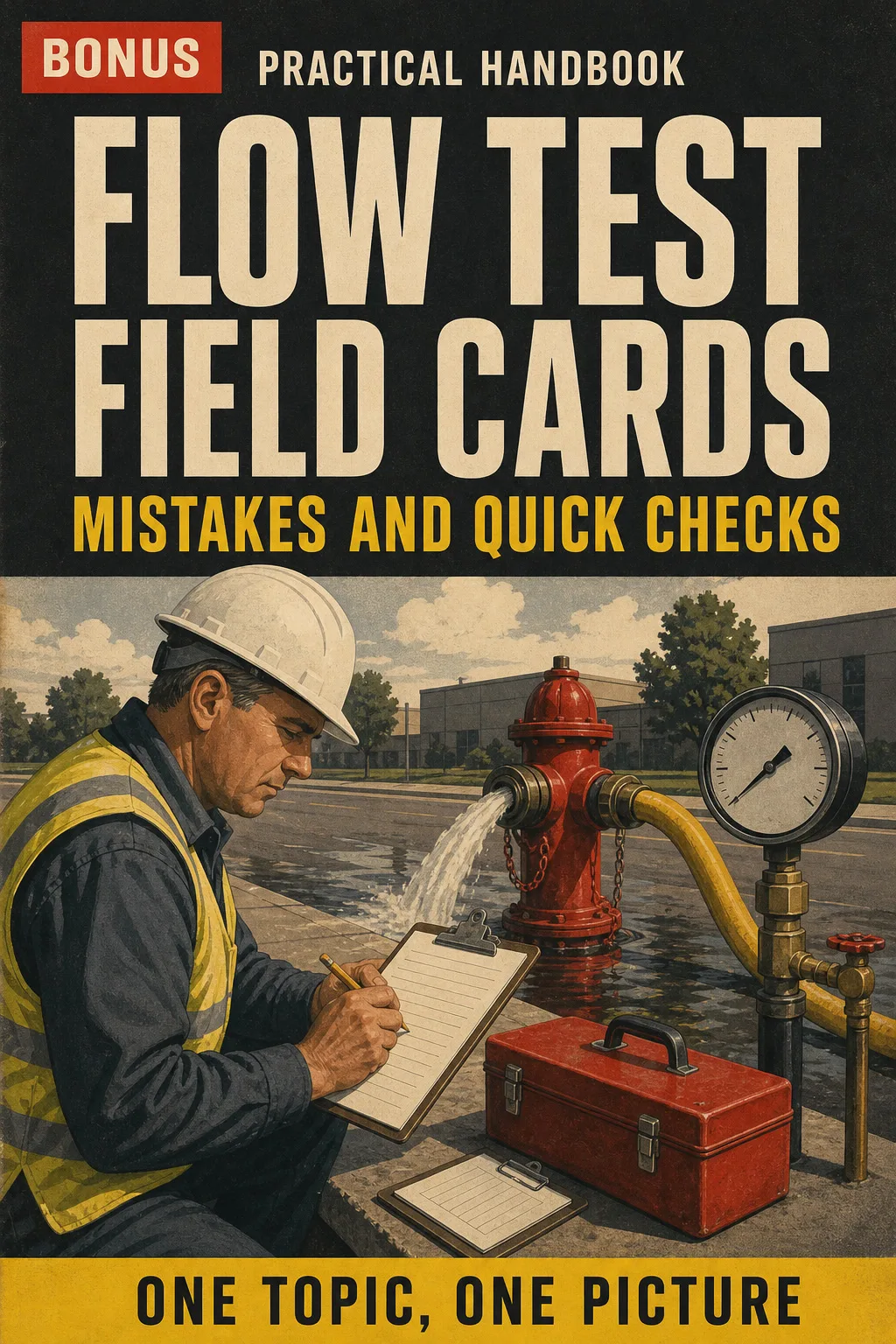
Plus: 2 Free Books

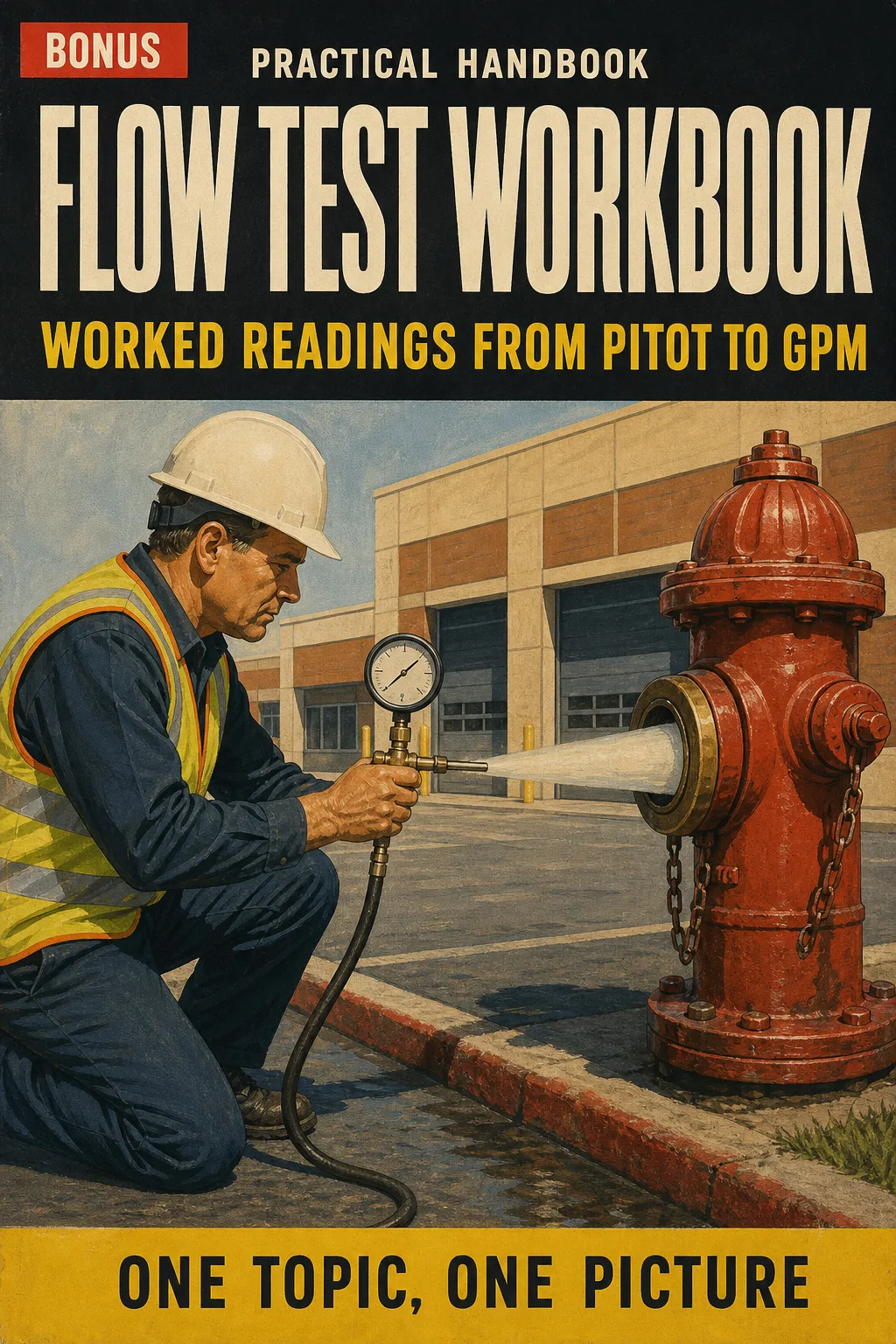
Flow Test Workbook: Worked Readings from Pitot to GPM

BONUS 1: «Flow Test Workbook: Worked Readings from Pitot to GPM»

Value on its own: US$ 17.90

Practice with real-world readings, from pitot pressure to gpm and the 20 psi flow, and check every answer step by step before you're out on the street.

Flow Test Field Cards: Mistakes and Quick Checks

BONUS 2: «Flow Test Field Cards: Mistakes and Quick Checks»

Value on its own: US$ 14.90

The most common flow test mistakes and the quick checks that prevent them, on printable cards you can keep in the truck.

Hydrant Flow Testing Illustrated with 2 Free Books

  • Hydrant Flow Testing Illustrated: 67 illustrated pagesUS$ 63
  • BONUS 1: Flow Test Workbook: Worked Readings from Pitot to GPMUS$ 17.90
  • BONUS 2: Flow Test Field Cards: Mistakes and Quick ChecksUS$ 14.90
  • High-resolution PDF to printIncluded
Total value US$ 95.80
YOUR PRICE:
US$ 27
You save US$ 68.80
YES, I WANT HYDRANT FLOW TESTING ILLUSTRATED FOR US$ 27

📄 This is a digital PDF book sent to your email: nothing is printed or shipped.

Secure purchaseEncrypted payment30-day guarantee

PDF by email: We email you Hydrant Flow Testing Illustrated as a PDF, together with the two free books. It's a single payment: no installments, no extra charges.

Who This Book Is For

You're new to flow testing

You're new to flow testing

You see the whole test drawn in 6 steps, from the test hydrant to the report, before you ever open a cap.

Your first tests are coming up

Your first tests are coming up

Print the pages you need and keep them in the truck: the pitot position, the coefficients and the Q20 formula at a glance.

You already sign flow test reports

You already sign flow test reports

One fixed order for every test and every crew, and numbers you can defend when the engineer reads your report.

Everything You Get Today

US$ 95.80US$ 27
YES, I WANT HYDRANT FLOW TESTING ILLUSTRATED FOR US$ 27

📄 This is a digital PDF book sent to your email: nothing is printed or shipped.

30DAYS
GUARANTEE

30-Day Guarantee

Try Hydrant Flow Testing Illustrated for 30 days, bonus books included.

We refund everything if the file won't open, if the book isn't what you see here, if you were charged twice or if the email doesn't arrive. Just email us.

You pay once. No subscriptions.

Frequently Asked Questions

Is it for me if I've been running flow tests for years?

Yes. It isn't a beginner's book: it gives you one fixed order for every test and the numbers at a glance. It also covers private mains and standpipes, not just street hydrants.

Where does the content come from?

It's checked against the current editions of the US recommended practice: NFPA 291 for flow testing and hydrant marking, NFPA 25 for private mains and standpipes, and AWWA Manual M17 for hydrant operation. US units throughout: psi, gpm and inches.

Is it official material?

No. It's an independent illustrated book. It names those documents only to say what it covers and is not affiliated with or endorsed by NFPA or AWWA.

Does it replace training?

No. It's study and reference material: it doesn't give a certificate or continuing education credits. It doesn't replace hands-on training, your utility's or employer's procedures, or what the authority having jurisdiction requires.

Are the practice readings from an exam or an official source?

No. The worked readings and the self-check are written for this book, to practice going from pitot psi to gpm and Q20.

How do I get it?

As a PDF by email, sent to the address you enter at checkout. The 2 bonus books come as PDFs too.

Do I have to pay every month?

No. It's a one-time payment.

Can I have it on paper?

We don't ship paper copies. It's a PDF made to print at home or at any print shop, so you can keep the pages you use most in the truck.

How does the refund work?

You have 30 days. We refund everything if the file won't open, if the book isn't what you see on this page, if you were charged twice or if the email doesn't arrive: just email us.

Before You Close This Page

No more rereading and still guessing.

The pitot, the coefficients and Q20: you see them drawn, and that's it.

You get to the hydrant knowing where everything is.

Drawings make studying faster.

The book is right below.

One-time payment: US$ 27 · Guarantee: 30 days · PDF by email

YES, I WANT HYDRANT FLOW TESTING ILLUSTRATED FOR US$ 27

📄 This is a digital PDF book sent to your email: nothing is printed or shipped.